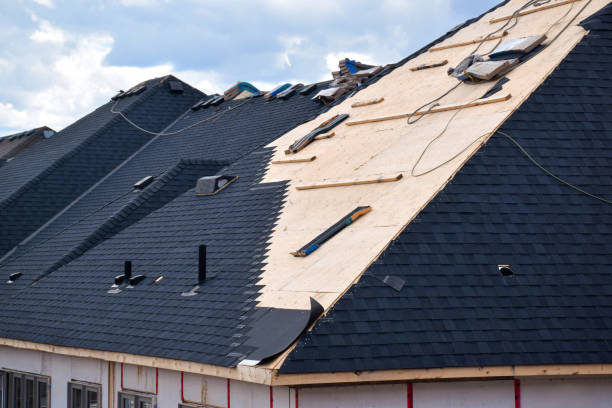
A small drip on your ceiling is the tip of the iceberg. By the time water is visible inside, it has likely soaked your insulation, rotted your decking, and encouraged mold growth. We are Roaring Spring, PA’s forensic roofing specialists. We specialize in roof leak repair, using our knowledge of water dynamics to trace the leak back to its source and seal it permanently.
Roaring Spring, PA storms can be brutal. High winds can lift shingles, and hail can crack them. If you have storm damage, we offer emergency roof repair. We will tarp the damaged area immediately to stop water intrusion. Then, we perform a permanent repair that matches your existing roof as closely as possible.
We fix the "hard" leaks that handy-men miss.
Many amateurs try to fix roofs with a tube of caulk. This is a temporary band-aid that often traps water and makes the rot worse. We fix roofs the right way—by removing the damaged material, repairing the underlayment, and installing new shingles and flashing integrated properly with the roof system.
Don't ignore the stain on the ceiling. Let our expert technicians find the leak and fix it right the first time.
Call for emergency repair: 18339572356
"I had a mystery leak that ruined my drywall twice. This team found a nail pop under a shingle that everyone else missed. Genius."
"A tree branch punched a hole in my roof during a storm. They were out within hours to tarp it and fixed it the next day."
"Honest guys. They told me I didn't need a new roof, just some new flashing around the chimney. Saved me thousands."
Roaring Spring was established around the Big Spring in Morrison's Cove, a clean and dependable water source vital to the operation of a paper mill. Prior to 1866, when the first paper mill was built, Roaring Spring had been a grist mill hamlet with a country store at the intersection of two rural roads that lead to the mill near the spring. A grist mill, powered by the spring water, had operated at that location since at least the 1760s. After 1867, as the paper mill expanded, surrounding tracts of land were acquired to accommodate housing development for new workers. The formalization of a town plan, however, never occurred. As a result, the seemingly random street pattern of the historic district is the product of hilly topography, a small network of pre-existing country roads that converged near the Big Spring, and the property lines of adjacent tracts that were acquired through the years for community expansion. The arterial streets of the district are now East Main, West Main, Spang and Bloomfield, each of which leads out of the borough to surrounding townships. Two of these streets — Spang and East Main — meet with Church Street at the district's main intersection called "Five Points." The boundaries of the district essentially include those portions of Roaring Spring Borough which had been laid out for development by the early 1920s. This area encompasses 233 acres (0.94 km2) or 55 percent of the borough's area of 421 acres (1.70 km2). Since the district's period of significance extends to 1944, most of those buildings erected after the 1920s were built as infill within the areas already subdivided by the 1920s. In the early 1960s, the borough began to annex sections of adjacent Taylor Township, especially to the east around the then new Rt. 36 Bypass.
Zip Codes in Roaring Spring, PA that we also serve: 16673